
Thursday, May 14, 2026
RFP vs RFI vs RFQ: What's the Difference and When Each Is Used

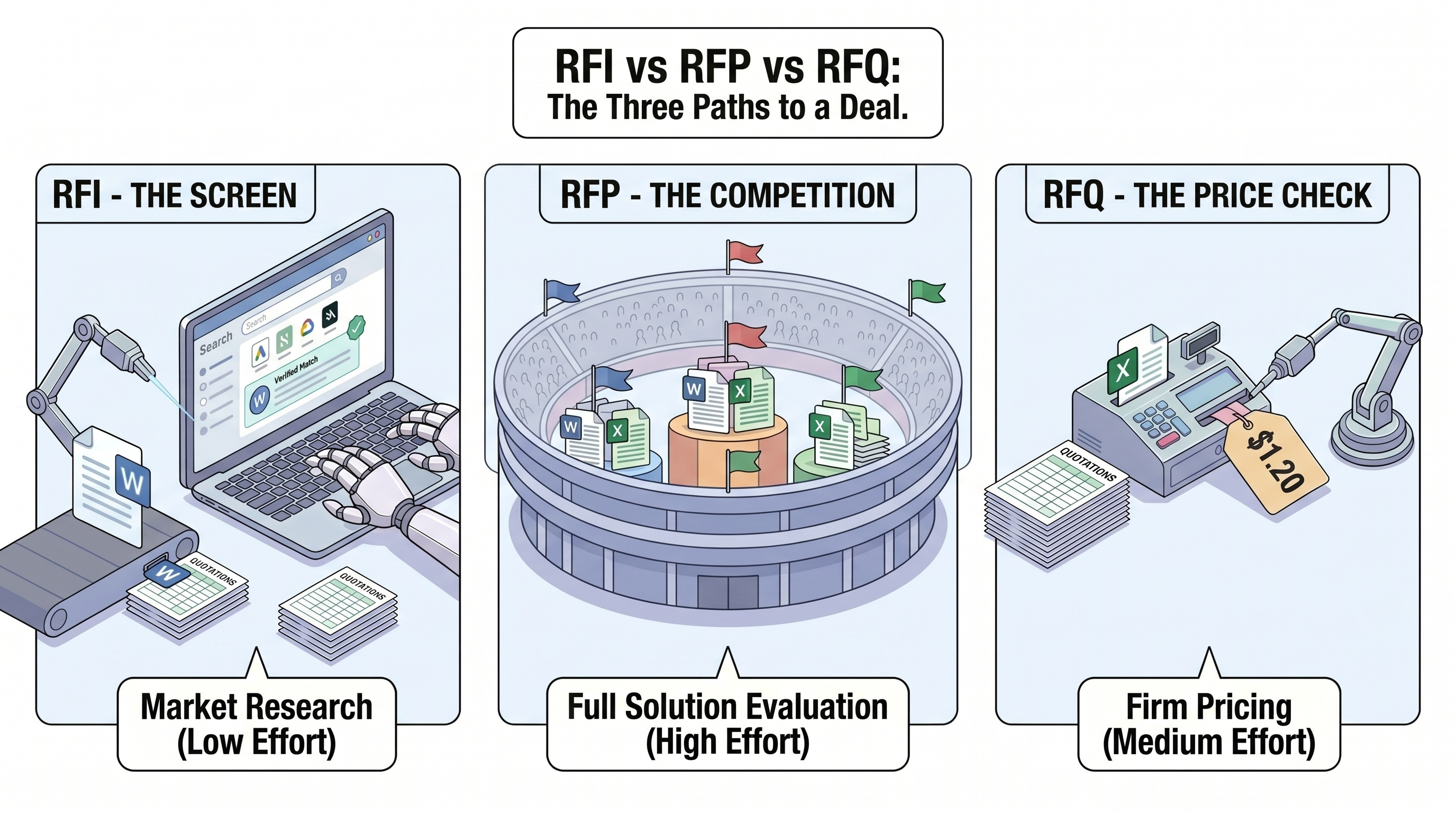
A buyer emails you a 187-page document with 412 questions, a two-week deadline, and a subject line that just says "RFP." A second buyer sends a single-page spreadsheet asking for pricing across six SKUs and calls it an RFP too. A third buyer sends a short questionnaire asking how long you've been in business and whether you sell in the EU — and calls that an RFP.
Only one of them is actually an RFP. The other two are an RFQ and an RFI. The RFP vs RFI vs RFQ distinction matters because each document tells you something specific about what the buyer is doing, how much effort the response should take, and what a "good" answer looks like. Treating an RFI like an RFP wastes a week. Treating an RFQ like an RFI loses you the deal on price.
This is a working glossary for anyone newly involved in responding — proposal managers, sales engineers, founders writing their first one. It covers what each document is, what buyers actually do with it, and what a useful response looks like on the responder side.
TL;DR — the difference in one paragraph
An RFI is a screen, an RFP is a competition, and an RFQ is a price check. Buyers send an RFI when they're still learning the market and trying to narrow a long list of vendors down to a shortlist. They send an RFP when they have a shortlist and want to compare full solutions side by side. They send an RFQ when the spec is already locked and the only meaningful variable left is price.
The mechanical differences follow from that. An RFI is short — usually 5–30 open-ended questions — and you can typically respond in 1–2 weeks with a few hours of focused work. The buyer evaluates on capability and fit, and the document tends to arrive as a Word doc or a simple web form.
An RFP is the heaviest of the three. It's normal to see 75 to 500+ questions across solution, security, references, implementation, and commercial terms. Response timelines run 2–6 weeks, and teams report spending 20–40 hours per RFP. Procurement leads the process but the buying team, InfoSec, and legal all weigh in. RFPs arrive in every format imaginable — Excel, Word, PDF, or a vendor portal.
An RFQ is the lightest in effort but the strictest in format. It's typically a list of 5–50 line items (an Excel sheet or an e-procurement portal), evaluated on price, lead time, and terms. Procurement owns it end to end. The deadline is short — often 3–10 business days — and the work is less about content and more about hitting the buyer's structure exactly.
What is an RFI?
A Request for Information is a buyer's way of doing market research without committing to a purchase. It usually goes out early in a procurement cycle — sometimes before the buyer even has formal budget. The questions are open-ended and qualitative: Do you serve customers in our industry? What's your typical implementation timeline? Which compliance frameworks do you maintain?
The buyer is trying to build a shortlist. They might send the same RFI to 8–12 vendors, then use the responses to narrow the field down to 3–5 they'll invite to an RFP.
What a good RFI response looks like. Short, specific, and honest about fit. RFIs are not the place to throw the entire pitch deck at the buyer — they're the place to make a credible case that you're worth inviting to the next round. Most RFIs are 5–30 questions and can be answered in a few hours if your team has decent organizational memory; if it takes you four days to answer one, you have a content library problem, not an RFI problem.
The trap. Treating an RFI as a sales opportunity and writing 800-word essays in answer boxes meant for 50 words. Buyers screen for clarity. Wordy answers get filtered out.
What is an RFP?
A Request for Proposal is the main event. The buyer has decided what they want, knows roughly what it should cost, and is asking 3–7 shortlisted vendors to submit a full proposal. RFPs evaluate the whole package: the solution itself, implementation, support, references, security and compliance, commercial terms, and price.
An RFP is the document that drives most of the response-management market. Gartner tracks the entire category under RFP Response Management Applications — Loopio, Responsive, Ombud, Qvidian, RequestFX, and others. It's a category because RFPs are genuinely hard to respond to well.
A real RFP usually contains:
- A statement of work or scope description
- Functional and technical requirements
- A security and compliance section (often a CAIQ, SIG, or custom security questionnaire embedded inside)
- Implementation and support questions
- Reference and case-study requests
- A pricing schedule
- Submission rules: format, page limits, deadline, point of contact
The response itself routinely runs 30–200 pages and pulls in sales, sales engineering, product, legal, finance, and (for any non-trivial deal) security and GRC. Teams report spending 20–40 hours per RFP, with nearly half of that time spent searching for previously written answers rather than writing new ones. The Association of Proposal Management Professionals has built an entire body of knowledge around the discipline.
What a good RFP response looks like. Compliant before clever — every section answered, every required artifact attached, every word count respected. Then specific: tailored win themes, named references in the buyer's industry, concrete implementation timelines. Then honest about scope: don't promise features that don't exist, and don't quietly skip the security questions you can't answer.
The trap. Two of them. First, treating the RFP as a writing exercise instead of a project — RFPs are won and lost by the project plan, not the prose. Second, recycling a competitor's answer or a stale boilerplate response that no longer reflects the product. G2 reviews of legacy RFP tools consistently call out content decay — answers approved 18 months ago still showing up in proposals, with no one quite sure whether they're still true.
What is an RFQ?
A Request for Quotation is a price-focused document. The buyer already knows exactly what they want — make, model, quantity, delivery terms — and they're asking suppliers to quote on those line items. RFQs are common in procurement of commodities, hardware, professional services with well-defined scopes, and renewals where the buyer is checking the market.
The structure is tabular: a list of items or services, columns for unit price, total price, lead time, and terms. The buyer compares quotes on price first and on terms second. Per CIPS, the procurement profession's standards body, RFQs are typically used when specifications are clear enough that price is the meaningful variable.
What a good RFQ response looks like. Fast, complete, and exactly on the buyer's format. RFQs are often filled out in the buyer's e-procurement portal (Ariba, Coupa, ServiceNow, custom portals) with field-level validation and line-item math. Get the math right, hit the format, return on time. That's most of the job.
The trap. Editing line-item descriptions to fit your SKUs. Procurement teams compare on a like-for-like basis; if your row doesn't match their row, it gets disqualified.
How the three fit together in a real procurement cycle
In a clean, textbook procurement cycle, the documents come in order:
- RFI — buyer surveys the market and narrows from ~12 vendors to ~5.
- RFP — those 5 vendors submit full proposals; the buyer picks a winner (or two finalists).
- RFQ — the winning vendor formalizes price and terms before contract.
In practice, the cycle compresses. Mid-market deals often skip the RFI entirely — the buyer goes straight from market research on G2 and analyst reports to an RFP. Renewals often skip the RFP and go straight to an RFQ. Some buyers, especially in regulated industries, layer a separate security questionnaire (CAIQ, SIG, HECVAT, or a custom one) on top of the RFP, which is functionally another full response project. SafeBase reports that the security review alone can add 6+ days to a sales cycle, with 88% of organizations taking over two weeks per assessment when done manually.
The practical implication for responders: read the document, not the subject line. A "RFP" with 12 questions about pricing on a known SKU list is an RFQ. A "RFP" asking whether you serve healthcare and how long you've been in business is an RFI. Match your effort to what's actually being asked.
What responding to each actually looks like
The mechanical difference between an RFI, an RFP, and an RFQ shows up in three places: who needs to be involved, how much content you're producing, and how the deliverable gets back to the buyer.
RFI: solo-able for an experienced responder. A proposal manager or sales engineer with access to the company's content library can usually answer an RFI in 2–4 hours. The only friction comes when the library is out of date — when answers about certifications, leadership, or geographic coverage are 18 months stale.
RFP: a cross-functional project. Even small RFPs need at least four people: a project owner (usually proposal manager), a sales lead, a sales engineer for technical questions, and someone on the security or GRC side for the compliance section. Bigger RFPs add product, legal, and finance. Coordination is the bottleneck, not writing. Most missed deadlines are caused not by inability but by ownership and tracking failures — questions sit unanswered until someone notices.
RFQ: procurement-portal compliance. RFQs are often submitted through buyer portals with field validation and required formats. The work is less about content and more about hitting the buyer's structure exactly.
The shift over the last two years is that AI-native response tools — including RequestFX — have changed what the first pass of each looks like. Instead of starting with a blank document, responders start with a draft that's already populated from the company's knowledge base, with citations back to the source documents. The reviewer's job becomes editing and approving rather than searching and writing.
A few practical notes on what AI handles well and what it doesn't:
- It handles well: repetitive boilerplate (company background, certifications, common security questions), questions that have been answered before with documented sources, and reformatting answers to fit the buyer's structure.
- It doesn't handle well: win themes, executive summaries, pricing strategy, and any question that requires judgment about the specific deal. Those still need a person.
RequestFX is built for the first category. You upload your company's documents to the knowledge base once. When a new RFP, RFI, or RFQ arrives — as a PDF, Word doc, Excel sheet, PowerPoint, or web portal — the system parses out the questions, generates grounded answers with citations back to the source documents, and flags each answer as Complete, Partial, or Not answered so reviewers know where to focus. For Excel-based questionnaires and web portals, the completed answers get written back into the original file or web form automatically.
Where to start
Whether the documents hitting your inbox are full-scope RFPs, shorter RFIs, or structured RFQs, the underlying workflow is the same: a knowledge base of source documents, an AI that drafts grounded answers with citations, and a focused review pass to clean up the edges.
RFP automation is the best place to see how that works in practice — the page walks through how RequestFX handles long, cross-functional questionnaires across Excel, Word, PDF, PowerPoint, and web portals. The same engine handles the lighter-weight RFIs and the structured RFQs that come in alongside.
If you want the full picture across response types — includting security questionnaires, due diligence questionnaires, and regulatory reports — the use cases overview covers all of them.