
Friday, January 23, 2026
When buying agents negotiate with selling agents

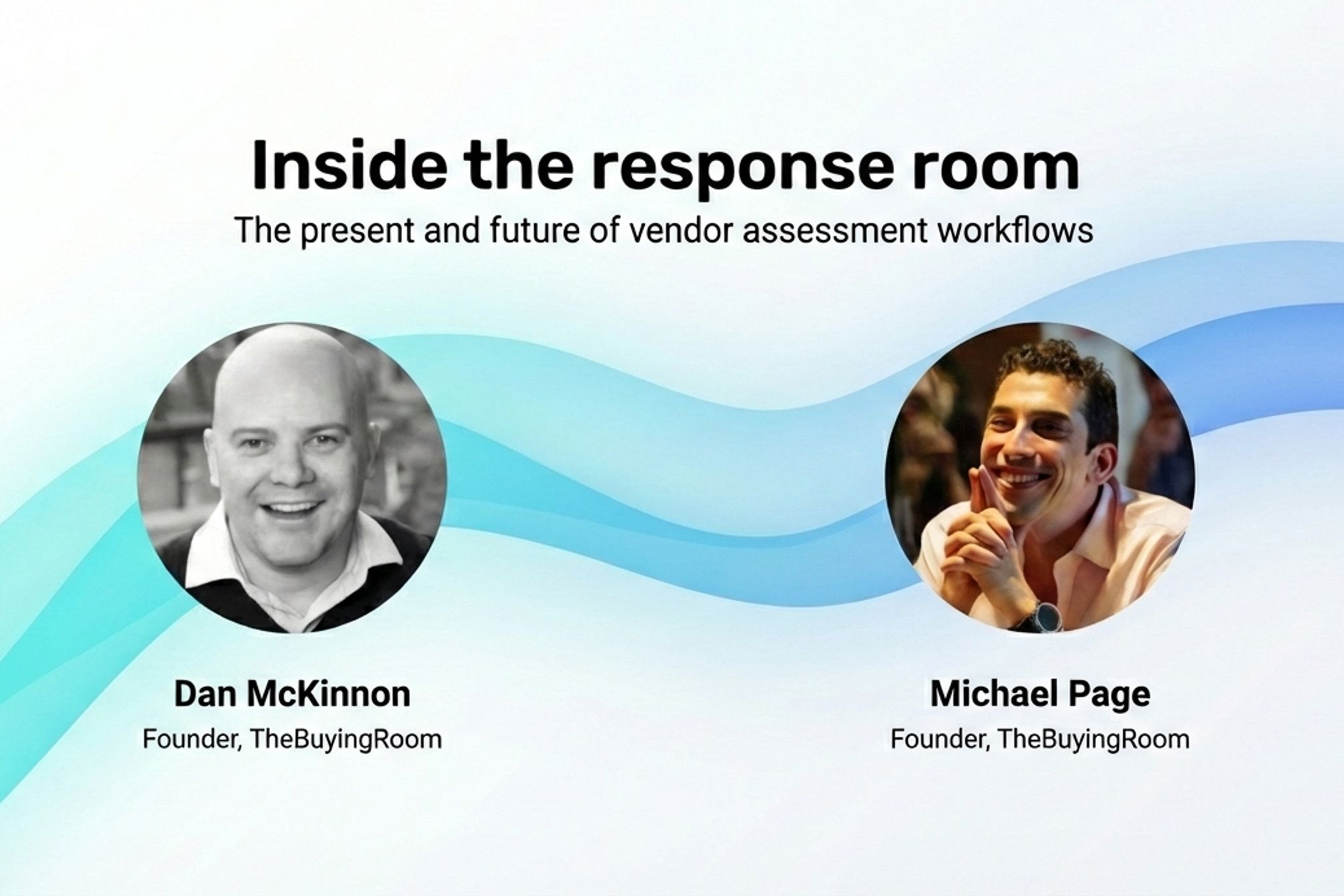
Welcome to Inside the Response Room, our blog series dedicated to exploring the present and future of vendor assessment workflows.
At RequestFX, we often discuss the pain of answering RFPs, but the process is arguably just as painful for the teams issuing them. We sat down with Michael Page and Dan McKinnon, co-founders of TheBuyingRoom, who argue that for business leaders, the traditional tender process has become a "100-Hour Panic Event." Instead of a strategic exercise, buying software has morphed into a frantic, high-stakes scramble where buyers attempt to manually map a market of 30,000+ vendors, gather internal requirements, and review mountains of spreadsheets in a short window. The founders believe this manual bottleneck creates a dangerous Decision Gap, where the market innovates faster than the buyer can actually make a decision, rendering the chosen solution outdated before the contract is even signed.
To fix this, TheBuyingRoom is moving the industry away from static, point-in-time documents toward a Living Blueprint. Instead of forcing buyers to run a new "panic event" every few years, this model allows them to maintain a dynamic set of requirements that evolves alongside their business. For vendors, this means that in the future they will need to shift the focus from writing persuasive marketing prose to providing Verified Intelligence—granular, data-backed proof points that an AI can read and validate instantly against the buyer's needs.
In this interview, Page and McKinnon paint a picture of a future defined by Continuous Functional Alignment, where "winning the deal" isn't the finish line. In this new world, an always-on engine constantly checks if a vendor still fits the blueprint. They predict this will lead to an era of Subscription Fluidity by 2030—a state where B2B companies can switch enterprise vendors as easily as consumers switch streaming services, based entirely on performance data rather than locked-in contracts.
Here is our conversation with Michael Page and Dan McKinnon on the death of the panic event and the rise of the autonomous economy.
Can you walk us through the specific moment or realization in your career when you decided that the classic sourcing model wasn't just inefficient, but actually broken beyond repair for modern software buying?
Dan: Drawing on 20+ years of experience on the vendor side—having seen both sides of the coin—the specific realisation came from the mismatch between the 2005 market and the 2025 reality. In 2005, you had roughly 250 vendors; human-led discovery and a static RFP actually worked. Fast forward to today, and we have over 30,000 vendors with new capabilities launching weekly.
We realised the model was broken beyond repair when I saw teams spending hundreds of hours on a single RFP 'event' that nobody actually enjoys, only to produce a snapshot of a moving target. The moment that decision is finalised, it begins to age.
Dan McKinnon
We realised the model was broken beyond repair when I saw teams spending hundreds of hours on a single RFP "event" that nobody actually enjoys, only to produce a snapshot of a moving target. The moment that decision is finalised, it begins to age and cannot adapt to the exponential pace of AI-driven market changes.
How do you convince a risk-averse CISO or General Counsel that a 'Quarterly Health Check' is safer than a 300-page point-in-time security questionnaire? Is there a cultural hurdle to moving from 'signed documents' to 'live monitoring'?
Michael: To a risk-averse CISO, I argue that a 300-page point-in-time questionnaire is actually a "snapshot of safety" that leads to Functional Drift—where you end up paying for tools that no longer fit the job because the market has evolved while your sourcing remained static. This snapshot becomes a liability the moment a vendor changes their architecture or a new vulnerability emerges.
We aren't removing rigor; we are delivering 'Rigor without Rigidity' by maintaining the same level of compliance and defensibility as a traditional tender, but doing so through an 'always-on' digital model.
Michael Page
A "Quarterly Health Check" provides continuous functional alignment and active portfolio management. It’s a shift from "signed documents" to "live monitoring". We aren't removing rigor; we are delivering "Rigor without Rigidity" by maintaining the same level of compliance and defensibility as a traditional tender, but doing so through an "always-on" digital model.
Does this mean the future of buying is essentially 'Always-On Sourcing,' where an AI is constantly shopping for me in the background? And if so, how does a vendor stand out to an algorithm that doesn't care about their marketing copy?
Michael: Yes, the future is "Always-On Sourcing". By using AI-driven background monitoring, we reduce the marginal cost of evaluating a vendor to near-zero.
For a vendor to stand out to an algorithm, they must move away from "marketing copy" and toward structured, verifiable data. Our platform uses AI to validate vendor answers against a "Living Blueprint" of business needs. Vendors will need to provide "Verified Intelligence"—granular, requirement-level proof points—to win in a system that values objective functional fit over sales narratives.
As we move toward Sourcing as a System, do vendors need to stop writing 'proposals' and start publishing 'structured data'? Do you foresee a standard 'Vendor Protocol' emerging that allows tools like ours to pipe data directly into tools like yours?
Dan: Absolutely. For "Sourcing as a System" to reach its full potential, the industry needs a "Vendor Protocol". Today’s data is locked in PDFs or gated behind "Contact Sales" buttons, which creates friction.
We use a tiered approach: "Baseline Intelligence" via AI-driven web searches for 100% market coverage, and "Verified Intelligence" for vendors who provide structured data via a Knowledge Base. Vendors who proactively publish structured data that pipes directly into a buyer's "Living Blueprint" will have a massive competitive advantage.
Until the RFP truly dies, what is your advice to these teams? How should they engage with a buyer who is trying to be more agile but is stuck in a legacy process? Is there a way for a vendor to 'hack' the process by offering a Dynamic Blueprint approach proactively?
Michael: My advice to Sales Engineers is to stop being reactive participants in a "panic event" and start becoming proactive partners in "Continuous Functional Alignment".
A vendor can "hack" a legacy process by offering the buyer a "Dynamic Blueprint" approach proactively. A key place to do this is the QBR. Traditional QBRs are instigated and run by vendors, but they are the opportunity to really put the customer front and center. Instead of just answering the RFP or delivering a standard update, use these sessions to provide a "Performance Gap Analysis" that shows how your specific capabilities map to their evolving business outcomes. Help the buyer move from a "snapshot" to a "system" even if their procurement department hasn't caught up yet.
If I’m a vendor, this sounds like the goalposts might move every quarter. How does a vendor protect themselves in a 'Dynamic' contract while still staying aligned with the buyer’s evolving needs? Does the definition of 'success' need to be rewritten in the contract itself?
Dan: Success needs to be redefined as "ongoing alignment with business outcomes" rather than just meeting static uptime SLAs. In a dynamic contract, vendors are protected because the "Living Blueprint" reflects the actual needs of the business as they evolve.
It’s not about moving goalposts; it’s about ensuring the vendor remains a strategic partner. If a buyer’s priorities shift (e.g., they now care more about AI integration), the vendor has a data-driven roadmap to maintain their "Functional Fit Score" and secure their renewal.
Do you foresee a near future where a buyer's 'Buying Agent' negotiates directly with a vendor's 'Selling Agent' (perhaps powered by a RequestFX instance) without a human in the loop for Tier 2 or Tier 3 purchases?
Michael: I foresee a near future where "Buying Agents" and "Selling Agents" handle the high-volume, lower-tier purchases. For Tier 2 or 3 purchases, a buyer’s agent could point their "Living Blueprint" at a vendor’s "Knowledge Base" (perhaps powered by RequestFX), and the two could negotiate based on functional fit and pre-set parameters without human intervention. This allows humans to focus on high-stakes, strategic partnerships.
What does the B2B sales cycle look like in 2030? Does the concept of a 'Sales Cycle' even exist, or does it become 'Subscription Fluidity,' where companies switch vendors as easily as consumers switch streaming services? And what does that mean for customer retention?
Dan: By 2030, the "Sales Cycle" as we know it will be replaced by "Subscription Fluidity". When the "Decision Gap" is near-zero, customer retention will depend entirely on continuous functional alignment.
If a vendor's "Functional Fit Score" drops because they’ve fallen behind on key capabilities, the system will instantly flag "New Entrants" who match the buyer's Blueprint better. Retention will be won quarterly through "Quarterly Health Checks," not every five years through a frantic RFP.